People search “NYSE: CRM” for two very different reasons. Some are looking up a stock. Others typed CRM into a ticker box thinking they were searching for customer relationship management software and landed on a quote page for a company worth a couple hundred billion dollars. This article is written for both, though mostly for the second group, because the confusion is genuinely useful: understanding why Salesforce became a public company worth watching tells you a lot about how the CRM market actually works.
Disclosure before we go further: I am a CRM consultant, not a financial advisor. Nothing here is investment advice. If you are making an investment decision, read the company’s own filings and talk to someone licensed.
What the ticker refers to
CRM is the ticker for Salesforce, the company that made cloud-based CRM the default way businesses run a sales pipeline. It has traded under that symbol since its 2004 initial public offering. “NYSE: CRM” is the label you will still see in older screeners, articles, and finance sites, and it is the phrase most people search when they want the quote page rather than a software review.
The symbol itself is the joke. Salesforce’s ticker is literally the category it created. That is either great branding or a warning about concentration, depending on your mood.
Why a CRM company became a market story
For most of the 2010s Salesforce was a growth story: revenue up 25% or more a year, losses treated as investment, and a stock price that rewarded land-grab behavior. That changed. The company has spent recent years optimizing for margin and cash flow, and the market’s reaction has been mixed in a way that is instructive.
The core insight is that CRM is not a niche. Almost every company with a sales team pays for one, the switching costs are high, and the contracts are multi-year. That produces predictable recurring revenue, which is a lovely thing to own. It also means growth has to come from either price increases, new products, or new segments, because the easy customers are already customers.
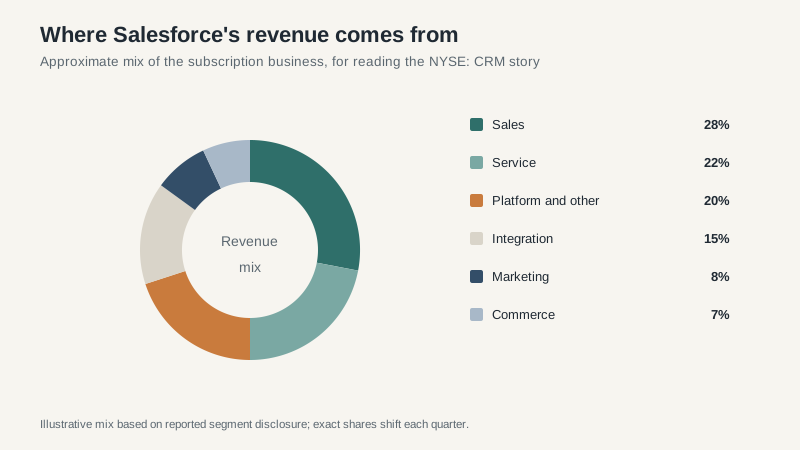
That mix matters more than the headline revenue number. Sales and Service are the mature engine. Platform and Data Cloud are where the growth argument lives. If you are reading a quarterly report, the segment mix tells you which of those is actually happening.
The four numbers worth checking
If you want to understand the business without reading a hundred pages, four figures carry most of the signal.
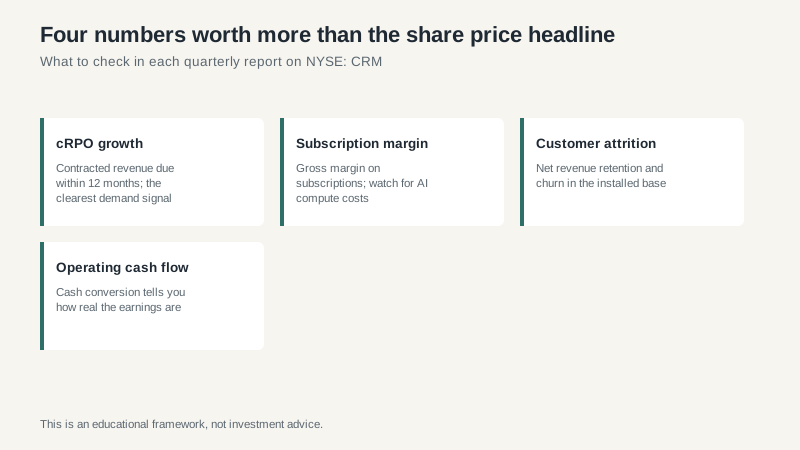
Current remaining performance obligation. Usually shortened to cRPO. It is contracted revenue the company expects to recognize in the next twelve months. It is the cleanest read on whether customers are still signing and renewing. Watch the growth rate, not the absolute number.
Subscription gross margin. How much of each subscription dollar survives after the cost of delivering it. This line is where AI infrastructure costs show up, and it is the number I would watch most closely over the next few years. Running inference for every customer is not free, and the market is still deciding whether AI features are a margin expander or a margin tax.
Attrition and net revenue retention. Salesforce reports attrition rather than the retention figure many software companies disclose. Either way, the question is the same: are existing customers spending more or less each year? A company with strong new sales and weak retention is filling a bucket with a hole in it.
Operating cash flow. The gap between accounting profit and cash is where aggressive revenue recognition hides. Cash flow is harder to dress up.
What actually moves the number
Three things, in my reading.
Seat growth versus seat compression. Salesforce prices per user. When customers get cautious, they cut seats before they cut the contract. A company that keeps revenue flat while seats fall is raising prices, which works until it does not.
AI monetization. The company has been explicit that AI products are priced on consumption or as premium tiers. Whether customers pay extra for those features, or treat them as table stakes bundled into renewals, decides a lot about the next five years. This is the single most consequential open question for the business.
Competitive pressure at the low end. HubSpot and the lighter tools have taken the small-business segment, and that segment eventually becomes the mid-market. Salesforce’s response has been to move upmarket and add products, which is a reasonable strategy and also the classic incumbent strategy that eventually runs out of room.
What this means if you are buying, not investing
The market story has a practical implication for buyers. A public company with a margin mandate has pricing discipline. Discounts are harder to get than they were five years ago, multi-year renewals are pushed harder, and add-on products are bundled into negotiations. If you are renewing, the leverage you have is timing and competitive alternatives, and the best moment to use it is when a renewal is eighteen months out and you can credibly start an evaluation.
It also means the product roadmap is shaped by what sells to large enterprises. Features that matter to a 12-person sales team are not where the investment goes. That is not a criticism. It is a reason small companies often find better value elsewhere.
If you are here because you wanted the software rather than the stock, start with the Salesforce CRM guide for editions and costs, or the best CRM software comparison if you are still deciding whether Salesforce is the right category for your team.
