Dealership software is its own universe. A general-purpose CRM assumes you sell a subscription to a company with one decision maker. A car dealer sells a depreciating asset to a stranger who walked in because of a $299 lease ad, against a trade-in that has to be appraised, financed through a lender with a rate sheet, and delivered before the customer’s lunch break ends. Elead CRM was built for that second world, and it shows in both the good ways and the annoying ones.
I have sat through Elead implementations at two franchised stores, one domestic and one import, and I have also watched a dealer try to force Salesforce to do the same job. The second project is the reason this article exists.
What Elead actually is
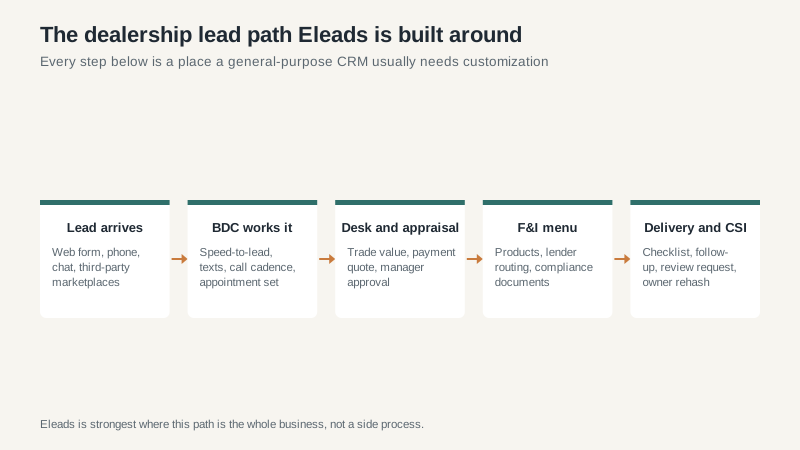
Elead CRM is a dealership-specific customer relationship management platform, now part of CDK Global, sold mostly to franchised new-car dealers. It handles the lead-to-delivery path that general CRMs treat as an edge case: internet leads from third-party marketplaces, BDC call and text cadences, appointment setting and show rate tracking, desking and trade appraisal, F&I product menus, and the follow-up sequence that runs for months after a customer drives off.
The difference is not that a general CRM cannot store a lead. It is that Elead already knows what a lead source is, what a BDC is, what a “be-back” is, and what a manager wants to see on a Monday morning. That vocabulary is baked in. In Salesforce, every one of those concepts is a custom object and a project.
Where it earns its money
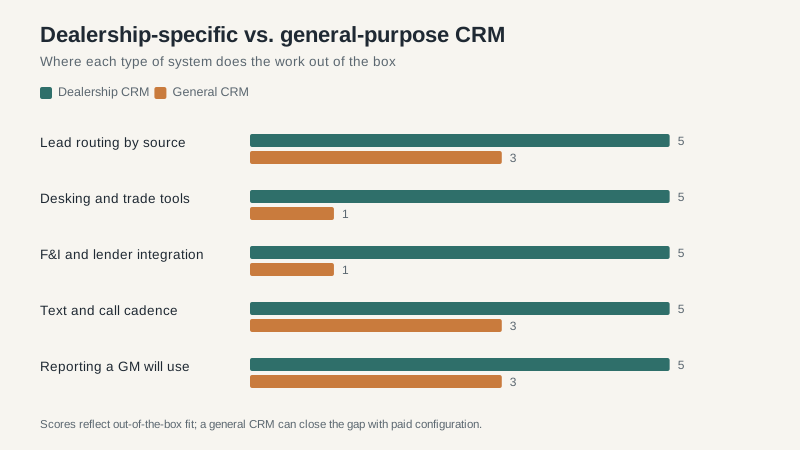
Lead response time is the first thing. Elead routes internet leads by source, round-robins them to the right BDC agent, and starts a cadence automatically. In a store doing 300 units a month, the difference between a five-minute response and a forty-minute response is worth more than the software costs. Every dealer knows this. Few general CRMs make it easy.
The second is desking and trade. Elead connects the CRM to the appraisal and desking workflow, so the manager working a deal sees the customer’s history, the trade value, and the payment structure in one place. When a customer comes back a year later, the equity position is right there. That is an equity mining feature, and for a franchised store it is the single most profitable thing a CRM can do.
The third is F&I. Product menus, lender routing, and compliance documentation live in the same system as the deal. In a general CRM, this is a separate tool bolted on with an integration that someone has to maintain.
Where it frustrates people
Dealer CRMs, Elead included, are not built for the person using them. They are built for the compliance officer, the general manager, and the OEM reporting requirement. The interface reflects that. Reps coming from a consumer-grade tool find it dense, and the training burden is real. Budget two weeks of ramp for a new BDC hire, not two days.
Support quality varies by region and by how much you spend. Dealers on the higher tiers get a named account contact and faster response. Dealers on the entry tier get a queue. I have heard both “they answered in ten minutes” and “we waited three days” from stores using the same product, which tells you the support experience is a function of contract tier and store relationship.
Pricing is opaque in the way dealer software usually is. Expect a per-store subscription in the low-to-mid four figures per month depending on user count and modules, plus onboarding fees. Getting a straight number before a demo is difficult, and I would treat any vendor that will not give you a written range as a warning sign.
The integration question
The CRM does not exist alone. It talks to the DMS, which at most US dealerships means CDK Drive or Reynolds, and it talks to the OEM lead feeds, the inventory tool, and the phone system. When those connections work, the store runs. When they break, you get duplicate leads and customers who get called twice by two different people.
Ask specifically who owns each integration and who you call when it fails. The answer is often “your CDK rep” for some pieces and “the third party” for others, and the seam between them is where problems live. Get that in writing before you sign.
Who should buy it
A franchised new-car dealer with a BDC and more than about 150 units a month should be looking at Elead alongside VinSolutions and the other dealer-specific platforms. At that volume, the vertical tool wins on day one because it already speaks the language.
An independent used-car lot doing 40 units a month with three salespeople probably should not. The feature depth you are paying for will go unused, and a simpler tool with a text cadence and a follow-up list will do the job for a fraction of the price. I have seen independents buy a franchised-store CRM and regret it within a quarter.
And if you are a dealer principal considering a general CRM because “it integrates with everything else,” be honest about what you are signing up for. You are signing up to build a dealership CRM inside a general CRM, and you will pay a consultant to do it. Sometimes that is the right call, particularly for a large group with multiple rooftops and a real IT function. For a single store, it is usually a very expensive way to avoid learning Elead’s interface.
If you are comparing at the category level rather than the store level, the framework in our best CRM software guide applies here too: fit and adoption beat feature counts, and the vertical tool wins whenever the process is genuinely specialized.
