Every “best CRM” list on the internet is really a list of the same eight products in a different order, and the order usually tracks whoever pays the highest affiliate commission. I have no affiliate deals and no vendor relationships, so here is the version I actually use with clients: a decision process, not a ranking.
That distinction matters because the honest answer to “what is the best CRM software” is “the one your team will still open in month nine.” Every product on this page can run a pipeline. The differences that decide the outcome are fit, adoption, and total cost, and those three vary by company far more than they vary by product.
Start with your sales motion, not a feature grid
Before you look at a single product, describe how a deal actually moves through your business. Not the ideal version. The real one, including the part where the founder gets involved at the end and the part where someone re-types the quote into a separate tool.
Most companies fall into one of a handful of shapes, and each shape points at a different starting shortlist.
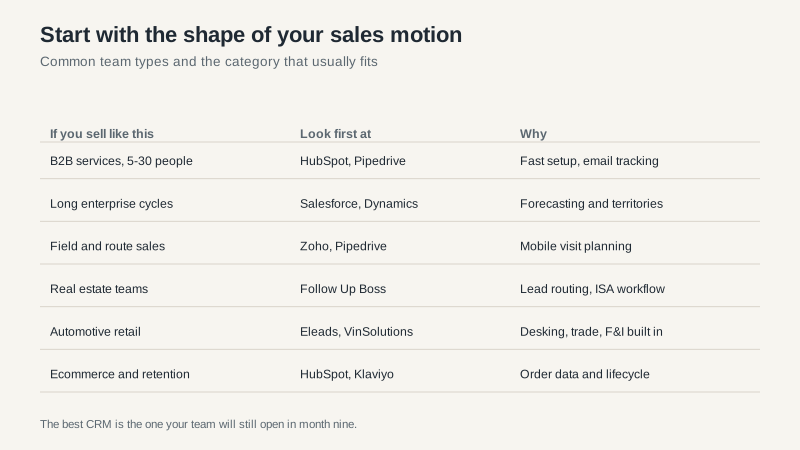
If you sell high-volume, short-cycle B2B, the deciding factor is speed: how fast can a rep log a call and move a deal. If you sell enterprise with six-month cycles and four approvers, the deciding factor is forecasting and permission structure. If you sell in the field, mobile matters more than any desktop feature. If you sell cars or houses, the vertical CRM will beat the general one on day one and it will not be close.
The five products that cover most of the market
HubSpot is the default for companies under 50 people with an inbound motion. Setup is fast, the record is unified, and marketing plus sales in one database is a genuine advantage. The cost curve is the catch, and I covered it in detail in the HubSpot breakdown.
Salesforce is the default for complex sales organizations. It will do almost anything, which is the reason implementation bills grow. If you have more than 30 reps, multiple business units, or a partner channel, it is usually the right long-term answer. The Salesforce guide covers editions and where the budget leaks.
Pipedrive is the best pure pipeline tool I have used. It is opinionated about activity-based selling and it does that one job beautifully. If your reps live in a kanban board and your reporting needs are modest, it is faster and cheaper than either of the leaders.
Zoho CRM is the value play. Broad feature coverage at a price that undercuts everyone, with an ecosystem of adjacent apps that can replace five subscriptions. The tradeoff is polish and support consistency, which shows up in month four rather than week one.
monday CRM wins when the sales process needs to look like the rest of the company’s work. If your operations and project teams already live in monday, putting sales there removes a tool boundary. Our monday CRM review covers what that flexibility costs you in discipline.
What actually separates them
I score every shortlist on six criteria, and then weight those criteria by what the client actually needs. The scores below are directional, not a ranking. A 5 in customization is worthless to a company that will never customize.
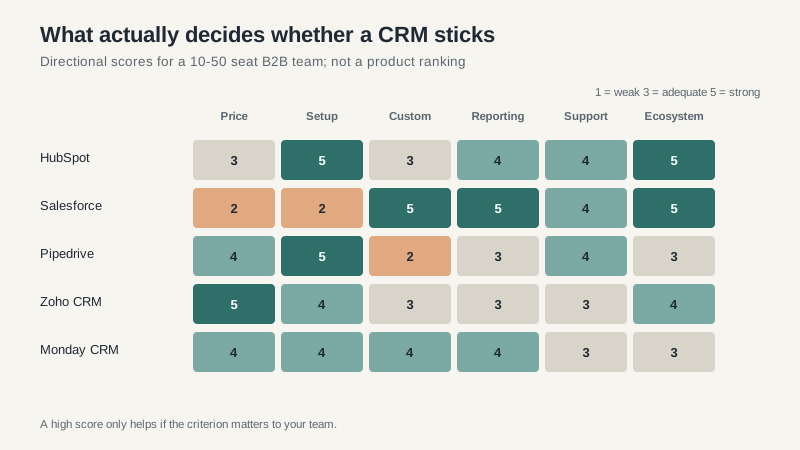
The pattern in that matrix is the whole argument. Salesforce is expensive and slow to set up and it wins on customization and reporting. Zoho is the reverse. HubSpot sits in the middle and wins on setup plus ecosystem, which is why it wins so many small-company deals.
Now weight it. For a 10 to 50 person sales team, this is roughly the weighting I use, and I show it to the buying committee before we score anything so nobody can move the goalposts afterward.
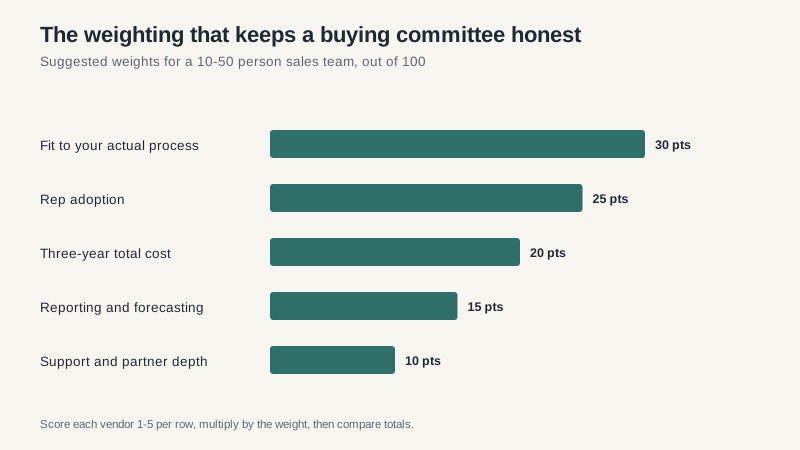
Process fit and adoption together carry 55 of 100 points. That is deliberate. Almost every CRM failure I have seen was a fit or adoption failure wearing a technology costume.
The questions that separate a good vendor from a good salesperson
Ask what happens to your data when you leave, and ask for the export in writing. Ask how much the export costs, because some vendors charge. Ask what breaks when you stop paying, and whether the account becomes read-only or disappears.
Ask who owns the implementation. If the answer is a partner, ask how the partner is compensated, because a partner paid on license volume has an incentive to sell you more seats than you need.
Ask to see the product handle your ugliest deal. Not your cleanest. Every CRM demo is a happy path. The system earns its keep on the deal with a partial shipment, a credit hold, and two contacts at the same company who hate each other.
Run a trial that produces a decision
Most trials are thirty days of clicking around and learning nothing. Run a structured one instead: load real accounts, have two reps work live deals, build the three reports your manager actually asks for, and price the full term before the trial ends. If a vendor will not support that, you have learned something useful.
Then check the total cost of ownership at three years, not one. Include implementation, integrations, admin time, and the cost of the person who will maintain it. The cheapest year-one quote is frequently the most expensive three-year contract.
One last thing. The best CRM software for your company is not a permanent decision, and treating it as one is how companies end up trapped. Pick something you can leave in three years without losing your customer history. That single criterion rules out more bad choices than any feature comparison ever will.
