HubSpot’s free CRM is the best free CRM I have ever recommended, and the recommendation has cost me two client relationships. Both times the client started free, grew into the paid tiers without a plan, and ended up paying more than they would have for Salesforce. Neither was HubSpot’s fault. The pricing model is just very good at making each individual upgrade feel small.
This is the article I send people before they sign up. It is not a hit piece. HubSpot is the right answer for a large group of companies. It is simply a product whose cost curve you should understand before you are standing on it.
What the free tier really gives you
Unlimited contacts and companies, one deal pipeline, basic email tracking, forms, and a shared inbox. For a team of two to five people who sell by email and want one place to keep notes, this is enough to run a business. I have seen solo consultants use it for years and never pay a dollar.
The free tier stops being enough at a specific moment: when you need a second pipeline, or when you need a workflow that does something more than send a notification. Those two needs arrive together for most teams, and they arrive at exactly the tier boundary.
The three bills
HubSpot pricing is not one number. It is three, and they move independently.
Seats. Sales Hub and Service Hub price per user. The Starter tier is modest, roughly $15 to $20 per seat per month. Professional jumps by a factor of four or five. Enterprise jumps again.
Marketing contacts. This is the one that surprises people. Marketing Hub is priced on the number of contacts you can market to, not the number of contacts you store. You can hold a million records and pay for ten thousand. But every contact you email, retarget, or track becomes a marketing contact unless you mark them otherwise, and the price steps up in bands.
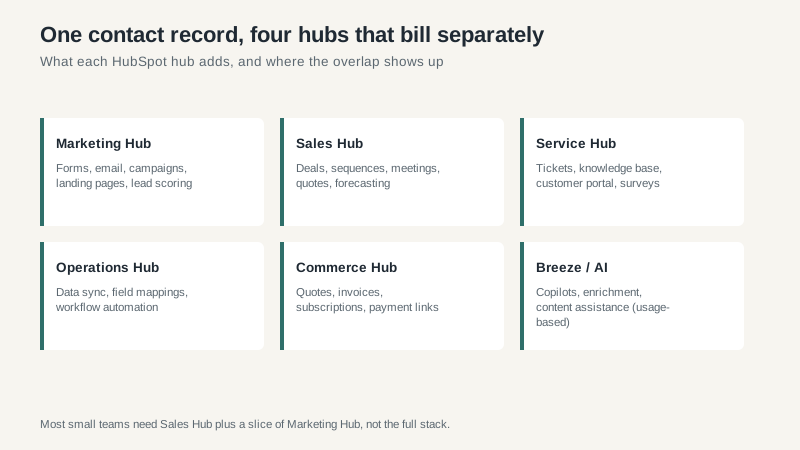
Hubs. Each hub is a separate subscription. Marketing, Sales, Service, Operations, Commerce. A company that wants forms, deals, tickets, and data syncing is buying four products that share one database.
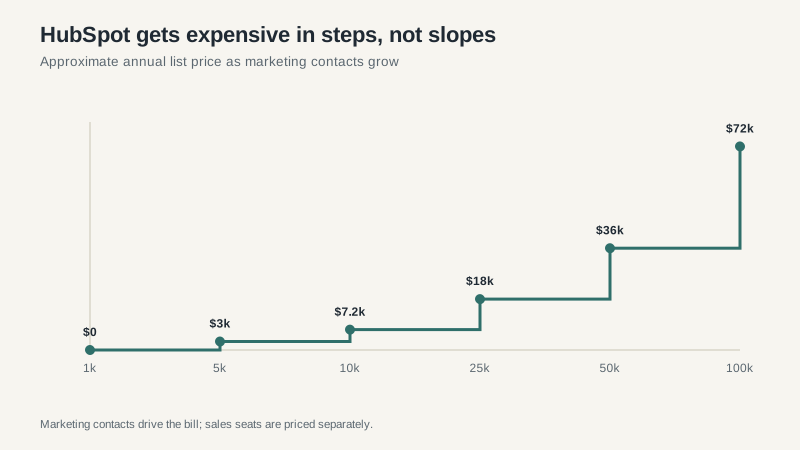
That step shape is the thing to internalize. HubSpot does not get more expensive gradually as you grow. It gets more expensive in jumps, and each jump is triggered by a contact threshold you cross without noticing.
Where HubSpot genuinely wins
The database is the product. Contacts, companies, deals, tickets, and marketing activity all live in one record with one timeline. When a support ticket sits next to a deal history and an email thread, a rep can answer “have we ever had a problem with this customer” in one screen. Salesforce can do this too, but it takes a project. HubSpot ships it.
Setup speed is the second advantage. A competent ops person can stand up a working sales pipeline in a day. The defaults are sensible, the editor is friendly, and the learning curve for a rep is measured in hours rather than weeks. I have never had a HubSpot rollout fail for lack of adoption. I have had several fail for lack of budget.
The third is the marketing side. If your growth depends on inbound, HubSpot’s marketing tooling is meaningfully better than bolting a marketing automation tool onto a sales CRM. Landing pages, forms, email, and attribution in one place is worth real money to the right company.
Where it hurts
Reporting is the recurring complaint. HubSpot’s report builder has improved a lot, but if you need a multi-object report with custom formulas and a specific layout for a board packet, you will feel the ceiling. Teams that live in spreadsheets tend to notice this in month two.
Custom objects exist on higher tiers, but the data model is still more rigid than Salesforce’s. If your business sells something unusual, a subscription with usage tiers and partner commissions and a renewal that splits across two entities, you will spend a lot of time explaining that to the platform.
And the pricing ladder is real. A company with 15 sales seats and 30,000 marketing contacts on Professional can easily reach $40,000 to $60,000 a year. That is not outrageous for what it delivers, but it is not the number anyone had in their head when they started on the free plan.
The upgrade path that avoids the trap
Two habits keep HubSpot affordable.
First, clean your marketing contacts quarterly. Anyone who has not opened, clicked, or been contacted in a year is a cost with no return. Marking them non-marketing is a five-minute exercise that can knock a whole pricing band off your renewal.
Second, buy hubs one at a time and only after you have used the previous one for a full quarter. The bundle discount is real, but it is smaller than the cost of paying for a hub nobody opens. I have watched companies buy Commerce Hub because it was 20% off in a bundle and never issue a single invoice through it.
Third, negotiate at renewal, not at signing. HubSpot’s sales team has more room on multi-year renewals than on new business, and the leverage is yours if you can credibly walk.
Who should pick it
If you are under 50 people, your sales motion is inbound or relationship-driven, and you want marketing and sales in one system, HubSpot is very hard to beat. If you are a services business that sells through email and calls, it is close to ideal.
If you have complex approval chains, a large partner channel, or a data model that needs custom objects everywhere, look at Salesforce first. If you are a five-person shop and the free tier covers you, stay there until it genuinely does not, and read our free CRM comparison before you assume the next tier up is the only option. The full platform comparison lives in the best CRM software guide.
The mistake is not choosing HubSpot. It is choosing it casually, on a credit card, and discovering eighteen months later that nobody has looked at the contact count since day one.
